
Sultan Khan
- October 12, 2025
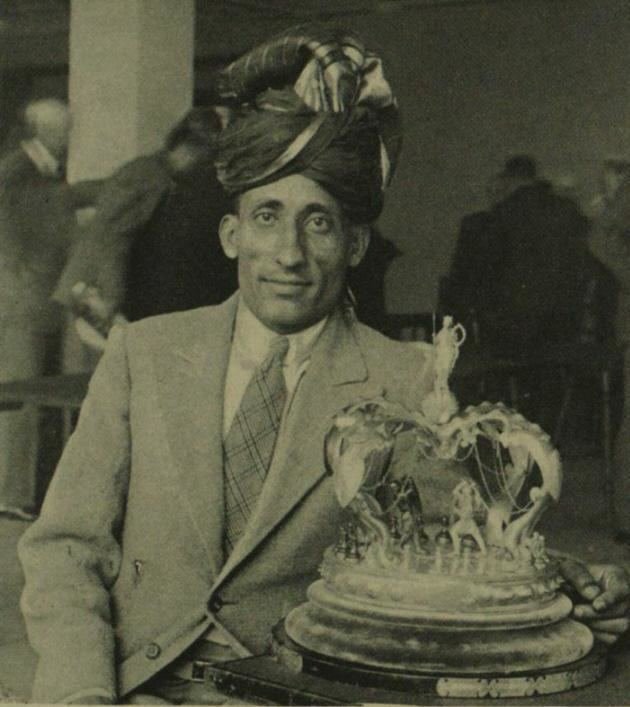
Ranking: ranked as high as sixth in the world for one month in 1933
Tournament Career: three-time British Champion
Chess Olympiads: no medal success
What earned him this recognition?
Looking at the statistical section of the article above, you might wonder, how is this possible? After all, most players who finished behind Khan in this ranking achieved more. And I agree. Yet I insist that Sultan Khan is a personality that must have a place on this list, as his chess career was largely unrepeatable and exceptional.
Sultan Khan was born in British India into a prominent Muslim family. When he won the national chess championship of India at the age of twenty-five, an Indian politician and family friend took him to England. There, Sultan Khan experienced his roughly five-year chess career. In his first tournament, he did not perform too well, as the European masters had the advantage of extensive theoretical knowledge. However, Sultan Khan quickly absorbed chess knowledge and playing strength to an unprecedented extent. What followed, no one expected. Three times in five years, he won the British Championship. Although he did not win first prize in any closed super-tournament of world players, he was, for example, third in Hastings behind Euwe and Capablanca, or third in a strong tournament in London only behind Alekhine and Flohr.
He also played balanced matches with the leading players of his time, defeating Tartakower and narrowly losing to Flohr. One of his best results came in Prague at the Chess Olympiad in 1931. Sultan played on the first board and achieved a fantastic result of 11.5/17, defeating Flohr and Rubinstein and drawing with world champion Alekhine and other stars.
In 1933, Sultan Khan returned to India, and his short and intense chess career ended. Many consider him the brightest chess talent of his time. The speed and ease with which he adapted to the very high level of the best European players and immediately began placing high in strong super-tournaments were very surprising and have not been repeated since. It is precisely this factor—his disadvantageous initial position in matches with European stars—that placed him in this subjective ranking of mine.
Why isn’t he higher:
His chess career was too short to fully realize his enormous potential. His talent was evidently at such a level that with proper training and diligence, he could have aspired to compete for the world champion title.
Best Game:
Sultan Khan vs José Raúl Capablanca
Hastings 1930
Support the author and help create more articles
Research and writing take hours. Your contribution keeps ChessDB.cz free of annoying ads and enables more frequent writing.
- 🎯 more quality articles
- ⚡ faster tool development
- 🖥️ server maintenance
Share
Miroslav Janeček graduated in English Philology at Palacký University Olomouc. Currently he works in Prague as a content editor for a large marketing company. His roots are in Opava - the historic and cultural centre of the Czech part of Silesia. That city is also the home of Slezan Opava, the chess club where Miroslav started to play chess, later went on to work as a youth coach and which he to this day proudly represents. As an aspiring chess publicist, he is the main author of articles on ChessDB.cz. In his free time, in addition to chess and writing, he also devotes himself to racket sports, history, and literature.