
Boris Spassky
- December 12, 2025
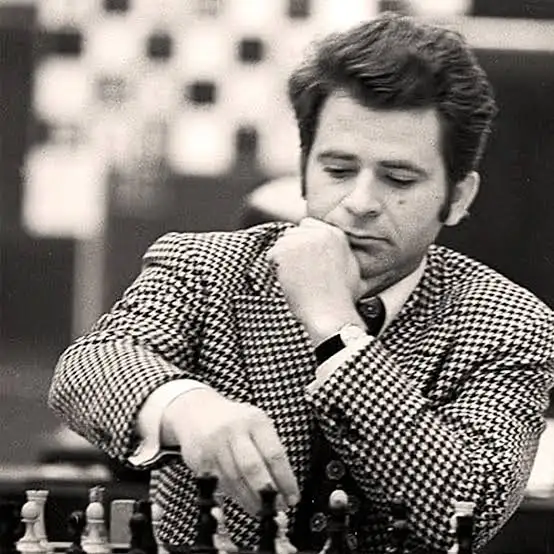
World Champion 1969 – 1972, winner of the title match 1969
Ranking: According to Chessmetrics, he was briefly the world number one in 1966. FIDE first released the Elo list in 1971 with Spassky in second place.
Highest FIDE Elo rating: 2690
Tournament career: Winner of 20 super-tournaments:
Candidate matches 1968
Candidate matches 1965
2x winner of the USSR Championship
2x winner of Amsterdam international chess tournament, Moscow chess tournament
Winner of Piatigorsky Cup 1966, Linares Chess Tournament 1983
and others…
Chess Olympiads: For the USSR: six gold and one silver team medals, three gold and two bronze individual medals. He also played three Olympiads for the French team.
Why he deserved it:
The recently deceased world champion Boris Spassky is today most known, paradoxically, for his greatest loss – in the match of the century in Reykjavik 1972 against Fischer. This is unfair to Spassky, as he himself was a giant who inscribed his name in golden letters in the history of chess.
The start of his career was meteoric; he was not yet twenty years old and was already playing in the Candidates Tournament in 1956. And he did not do badly at all, finishing in a tie for 3rd-7th place behind Smyslov and Keres. However, this was followed by a period of stagnation, and Boris failed to advance to the next two Candidates. This was partly due to personal problems, divorce, and other issues. Spassky also often had motivation problems in his career and did not have the bulldog nature of, say, Korchnoi or Karpov.
Eventually, Spassky managed to pull himself together, worked on himself, and began winning international tournaments. He became a consistent player in the world’s top ten and later the top five. From 1965 to the end of the sixties, he had his absolute best period, being a candidate to win every tournament he entered. His possibly greatest tournament victory came in 1966 at the Piatigorsky Cup in Santa Monica, where he won by half a point ahead of Fischer, and further ahead of Larsen, Portisch, Petrosian, Reshevsky, and others. Around that time, he was the world number one according to retrospectively calculated rankings. The first official FIDE ranking was published in 1971, at a time when Fischer already ruled the world (though not yet with the crown on his head).
In 1965, he finally qualified for the Candidates for the second time, which were now played in match format, and immediately dominated the entire cycle by defeating Keres, Geller, and Tal. In 1966, he challenged Tigran Petrosian for the chess throne. The tough and balanced match he narrowly lost.
The next Candidates cycle he won again after victories over Geller, Larsen, and Korchnoi, and this time he was too strong even for the titleholder Petrosian. In 1969, he thus completed his best period and, in a sense, his career, becoming the world champion.
Already as world champion, he played on the first board in the USSR vs World match, where he faced Larsen and scored 1.5/3 before being replaced by Stein in the last game. Otherwise, he continued with great results, but in the aforementioned match with Fischer, he had no chance against the genius American and did not defend his world champion title. The seventies after losing the title were clearly weaker for Spassky in terms of the number of tournaments won. However, he was still a strong Candidate, and that four more times. In 1977, he even reached the final of the Candidates matches and was a step away from another title match, but he could not match Korchnoi in his prime. Spassky was last a Candidate in 1985.
His swan song and one of the most valuable titles of his career, which no one expected at that time – was the tournament in Linares in 1983. Spassky won ahead of a host of stars, including the otherwise dominant world champion Karpov.
Spassky is known not only for his chess achievements but also for his versatility as a player, gentlemanliness, fair play, and calm and peaceful nature.
Best games:
Bent Larsen vs Boris Spassky
Match USSR vs World, Belgrade, 1970, round 2
Support the author and help create more articles
Research and writing take hours. Your contribution keeps ChessDB.cz free of annoying ads and enables more frequent writing.
- 🎯 more quality articles
- ⚡ faster tool development
- 🖥️ server maintenance
Share
Miroslav Janeček graduated in English Philology at Palacký University Olomouc. Currently he works in Prague as a content editor for a large marketing company. His roots are in Opava - the historic and cultural centre of the Czech part of Silesia. That city is also the home of Slezan Opava, the chess club where Miroslav started to play chess, later went on to work as a youth coach and which he to this day proudly represents. As an aspiring chess publicist, he is the main author of articles on ChessDB.cz. In his free time, in addition to chess and writing, he also devotes himself to racket sports, history, and literature.