
José Raúl Capablanca
- December 23, 2025
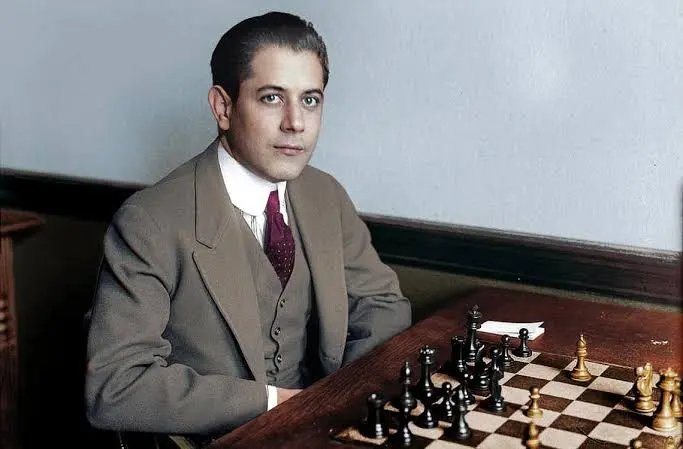
World Champion 1921 – 1927, winner of the 1921 title match
Chessmetrics Ranking: He was the world number one for a total of 85 months (57 consecutively) between 1914 and 1937.
Tournament Career: Winner of 16 super-tournaments:
7-time winner of the New York Chess Tournament
2-time winner of the Hastings Chess Congress
San Sebastián 1911
Nottingham 1936
and several others…
Matches: Except for the match with Alekhine, he won all the matches he participated in. His notable opponents included Marshall, Mieses, Lasker, Tartakower, and Euwe.
Chess Olympiads: Gold individual medal on the first board
Why he deserved it:
The third world champion José Raúl Capablanca was one of the greatest natural talents chess has ever seen. He excelled in endgames and had a gift for positional play. His style influenced later world champions Karpov and Kramnik.
His remarkable natural talent was evident right from his first participation in a strong super-tournament – in San Sebastián 1911. He entered the tournament as an unknown young player and left as a winner ahead of such legends as Rubinstein, Vidmar, Marshall, Tarrasch, Nimzowitsch, Schlechter, Maroczy, Janowski…
This unexpected victory opened the doors to other strong tournaments, and even before World War I, José was considered one of the best players in the world. Retrospective rankings also place him at the top of the world as early as 1914 and for the last time more than twenty years later in 1937.
During World War I, international chess mainly in Europe came to a halt, but Capablanca was able to play and win tournaments at least in America. Between 1916-1924, Capablanca was undefeated in competitive chess – he played fewer games than a player of his caliber would play over eight years today, but it was still an amazing streak. Capablanca’s streak included 40 wins and 23 draws. He played 63 games – interestingly, Fabiano Caruana played 64 games in just the calendar year 2025, which is an interesting comparison.
Capablanca’s streak included the world championship match with Lasker in 1921. After the war, Capablanca challenged the world champion based on his results, and they were eventually able to agree on terms. The younger and at that time already stronger Cuban defeated the famous German decisively and became the third world champion.
During the next six years, he did not defend the title, but in tournaments, he proved his status as the best player in the world. Among his great triumphs was the New York 1927 tournament ahead of Alekhine, Nimzowitsch, Vidmar, Spielmann, and Marshall. But later that same year, he faced an unexpected downfall. In the fall in Buenos Aires, Capablanca faced Alekhine for the world championship title and, contrary to expectations, lost the match 3:6 (=25).
This match marked a turning point in the chess scene – suddenly it was not Capablanca who dominated tournaments but Alekhine. The Russian master became at least as unbeatable after winning the title as Capablanca was before the match. Although Capablanca also continued to win tournaments, Alekhine won more. Moreover, Alekhine and Capablanca disliked each other after their match, and both refused to participate in a tournament where the other would play. For organizers, it was naturally more attractive to have the current world champion in the tournament, and so Capablanca was seen less and less, until in 1931 he stopped playing chess. Capablanca had tried to arrange a rematch with Alekhine, but he demanded the same conditions that Capablanca had set, and due to the global financial crisis following the stock market crash in New York, he was unable to raise the money. Perhaps this frustration also contributed to his career break.
In 1934, however, he returned to the chess circuit, having found new determination. And once again, he gradually worked his way back among the elite. In 1936, he achieved his last great success – at the super-tournament in Nottingham, he faced Alekhine for the first time since the 1927 title match and defeated him, eventually sharing first place with Botvinnik ahead of a host of stars – besides Alekhine, reigning world champion Euwe, Lasker (for whom it was the last tournament), Fine, Reshevsky, Flohr, Vidmar, Bogoljubow, and others also participated. It was clear that Capablanca was back, and at that time, according to historical rankings, he briefly returned to the world number one spot.
However, it was not enough to force another chance to become world champion. A new generation of players emerged – Keres, Botvinnik, Fine – and the generation of Alekhine and Capablanca was gradually retreating. This was fully demonstrated by the AVRO 1938 tournament, where the eight best players in the world competed. Keres won, and Capablanca and Alekhine finished at the back. At that time, Capablanca also began to have serious health problems related to high blood pressure, and the following year World War II broke out. These factors definitively ended Capablanca’s ambitions to return to the chess throne. Nevertheless, when he died in 1942 at only 53 years old, it caused a shock in the chess community. His predecessor on the throne, Lasker, had died just a year before, and he was twenty years older.
Capablanca is today generally considered one of the greatest chess players in history.
Best Games:
Jose Raul Capablanca vs Frank Marshall
New York 1918
Support the author and help create more articles
Research and writing take hours. Your contribution keeps ChessDB.cz free of annoying ads and enables more frequent writing.
- 🎯 more quality articles
- ⚡ faster tool development
- 🖥️ server maintenance
Share
Miroslav Janeček graduated in English Philology at Palacký University Olomouc. Currently he works in Prague as a content editor for a large marketing company. His roots are in Opava - the historic and cultural centre of the Czech part of Silesia. That city is also the home of Slezan Opava, the chess club where Miroslav started to play chess, later went on to work as a youth coach and which he to this day proudly represents. As an aspiring chess publicist, he is the main author of articles on ChessDB.cz. In his free time, in addition to chess and writing, he also devotes himself to racket sports, history, and literature.