
Robert James Fischer
- December 29, 2025
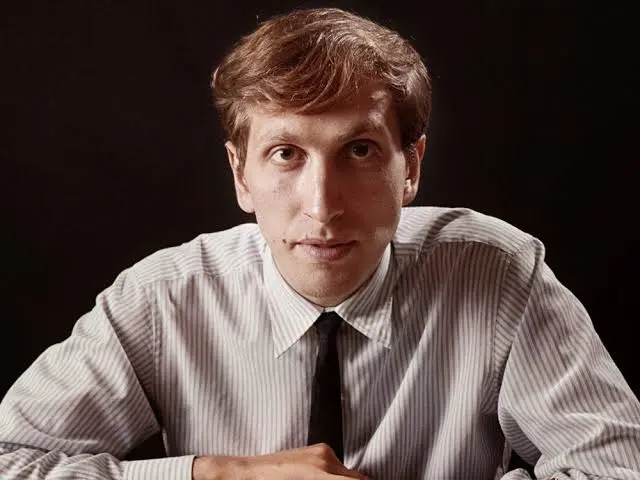
World Champion 1972 – 1975, winner of the 1972 title match
Highest Elo: 2785
Ranking: World number one according to Chessmetrics 1964 – 1965 and 1966 – 1971
World number one FIDE from the release of the first list in 1971 to 1976
A total of 122 months
Tournament career: winner of sixteen super-tournaments:
Candidate matches 1971
8x United States Champion
Winner of Mar del Plata 1960, Stockholm 1962, Monte Carlo 1967, Skopje 1967, Zagreb 1970, Buenos Aires 1970, Palma de Mallorca 1970
Chess Olympiads: two team silver medals, two individual silver and one bronze medal
Why he deserved it:
And we come to the greatest of the greats. American Robert James Fischer, known as Bobby Fischer, is perhaps the most famous chess player who ever lived. He achieved something that was long considered almost impossible. After more than two decades, he disrupted Soviet chess dominance. The Soviets pitted their entire machine against him, star players as opponents and their seconds and helpers. And yet they couldn’t match him.
Fischer was simply better than the rest throughout his career. It started when he was a teenager – he won the first of his eight U.S. Championship titles at the age of fourteen. And it wasn’t a weakly attended tournament at all, with star Reshevsky and other top American chess players participating. Fischer shares the record of eight U.S. Championship titles with Reshevsky today. His most famous title is his sixth, which he won at the age of twenty, because he achieved it with a 100% score. 11/11. This extraordinary feat has not been repeated to this day.
Fischer was only 15 years old when he first qualified for the Candidates Tournament, which remains an unbeaten record. Veterans of elite tournaments shook their heads, unable to understand how this confident and somewhat eccentric boy played so well. What they may not have known or appreciated was that Fischer not only had amazing talent but also dedicated all his free time and essentially his life to chess. At the 1959 Candidates Tournament, he finished tied for 5th-6th place out of eight. A very great result for a young debutant.
Soon after, Fischer began winning super-tournaments. In Mar del Plata 1960, he tied for first place with Spassky ahead of Bronstein and others. In 1962, at just nineteen years old, he won the interzonal tournament in Stockholm ahead of Geller, Petrosian, Korchnoi, and many other great players. This victory instantly made him one of the main favorites for the upcoming Candidates Tournament in Curaçao. However, he finished fourth behind Petrosian, Keres, and Geller, and shortly after the tournament, he accused these three players of having a prearranged draw pact to statistically prevent him from winning. Today, this accusation is considered true. All 12 games between these three players ended in draws with an average length of 19 moves. Fischer’s accusation was reviewed by FIDE and apparently reached the same conclusion as he did, as the format was changed to quarterfinal, semifinal, and final Candidates Matches from the next cycle.
Disappointed and disgusted by the Candidates Tournament, Fischer withdrew from chess activities for several years (except for the U.S. Championship) and did not participate in the next World Championship cycle. Instead, he played simultaneous exhibitions and gave lectures. But it was clear that this was the calm before the storm.
In 1966, he participated in the very strong Piatigorsky Cup in Santa Monica, where he finished half a point second behind Spassky but ahead of Larsen, Portisch, Najdorf, Reshevsky, and world champion Petrosian. This strong result announced his return.
In 1967, he won two super-tournaments, both against very strong fields. By this time, he was firmly established as the world number one according to retrospectively calculated rankings, a position he held until 1975. He was the main favorite for the interzonal tournament, which served as a qualification for the Candidates Tournament. Just before the halfway point of the tournament, Fischer was leading, but then his uncompromising and eccentric nature showed. After constant disputes with the organizers, he withdrew from the tournament and threw away the chance to win the world championship title. This was followed by another short period without any chess activity, during which his acclaimed book of chess games was published. However, this playing pause did not last as long as the previous one, and Fischer participated in the next World Championship cycle, which made him a legend. Few could have guessed that from this point on, Fischer would win everything he participated in.
In 1970, he played on the second board of the World team in the USSR vs World match. He defeated Petrosian 3:1. That same year, he won three very strong super-tournaments in Zagreb, Buenos Aires, and Palma de Mallorca. This wouldn’t be so surprising, but the way he won them was breathtaking. During these three long tournaments, he lost only two games and won them with a lead of two and twice three and a half points. The tournament in Palma de Mallorca was an interzonal tournament that qualified him for the Candidates Matches. It was this tournament that started the best winning streak in chess history. Bobby won the last seven rounds of the tournament. Seven consecutive victories.
In 1971, the Candidates Matches were played, and Fischer defeated Taimanov 6:0 in the quarterfinals. Thirteen consecutive victories. In the semifinals, he played against the Dane Larsen, to whom he had ceded the first board in the match against the USSR a year earlier. He also defeated him 6:0. Nineteen consecutive victories!! In the final, he faced Petrosian, with whom Fischer won the first game, achieving an incredible and still unbeaten streak of twenty consecutive victories against the strongest possible opposition of world masters. He eventually won the match against Petrosian 6.5:2.5.
And then there was only one last step left. Much has been said and written about the title match between Fischer and Spassky in Reykjavik 1972. Despite problems with cameras, chairs, spectators, and who knows what else, Fischer was simply the stronger chess player, and despite a bad start, he eventually defeated Spassky decisively 12.5:8.5. This completed the most dominant World Championship cycle in chess history. At the same time, although no one could have known it at the time, it ended his career because he did not participate in any competitive games afterward.
He made an exception in 1992 when he played a rematch with Spassky for the largest sum of money ever played for by two chess players. Such was the appeal of Fischer’s controversial personality to sponsors. Bobby won 17.5:12.5.
Bobby Fischer was the most dominant of all world champions. His perfect score of 11/11 in the U.S. Championship, the twenty-game winning streak, and the way he dominated the 1970-1972 World Championship cycle – these are results unparalleled in chess history. Fischer was not only the world number one, but he was also the long-term number one with the largest lead over the second player in FIDE Elo history. This lead was a full 125 points, and Bobby is still the only world number one who can boast a lead of over 100 points. The reason I did not place him in the top spot is the shortness of his career and thus the smaller number of matches and tournaments won. I decided to value not only dominance but also longevity and consistency. In my opinion, Fischer is not the greatest chess player in history, but he is an absolute legend and probably the most interesting player in the history of the game.
Best games:
Donald Byrne vs Robert James Fischer
New York 1956
Support the author and help create more articles
Research and writing take hours. Your contribution keeps ChessDB.cz free of annoying ads and enables more frequent writing.
- 🎯 more quality articles
- ⚡ faster tool development
- 🖥️ server maintenance
Share
Miroslav Janeček graduated in English Philology at Palacký University Olomouc. Currently he works in Prague as a content editor for a large marketing company. His roots are in Opava - the historic and cultural centre of the Czech part of Silesia. That city is also the home of Slezan Opava, the chess club where Miroslav started to play chess, later went on to work as a youth coach and which he to this day proudly represents. As an aspiring chess publicist, he is the main author of articles on ChessDB.cz. In his free time, in addition to chess and writing, he also devotes himself to racket sports, history, and literature.