
Garry Kasparov
- December 31, 2025
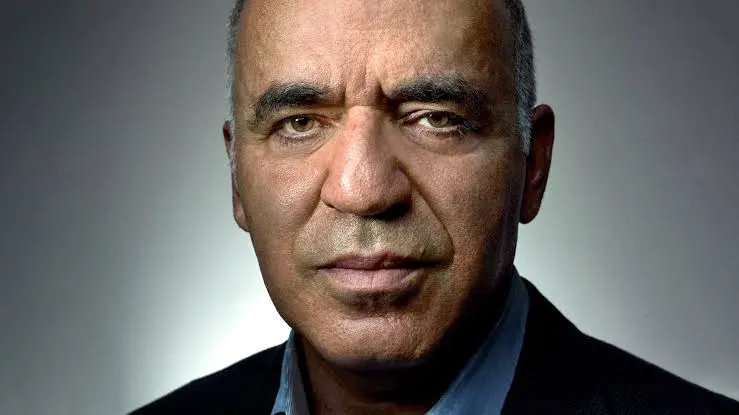
World Champion 1985 – 2000, 6-time title match winner (1985, 1986, 1987, 1990, 1993, 1995)
Second highest Elo in history: 2851
Ranking: World number one almost continuously for over 20 years 1984 – 2005, a total of 255 months
Tournament career: 44 victories in super-tournaments:
Candidate matches 1983-1984
9-time winner of the Linares Chess Tournament
3-time winner of Tata Steel Masters, Novgorod Chess Tournament, Tilburg Chess Tournament, Amsterdam Chess Tournament
2-time winner of the USSR Championship, 1-time winner of the Russian Championship
and many others…
Chess Olympiads: 8 team gold medals, four individual gold medals, one silver, two bronze
Why he deserved it:
Dear readers, allow me to thank you from the bottom of my heart for your support as we reach the end of this series. The year 2025 is over, and so is our series. I know many of you may disagree with some of my decisions, methods, or opinions. However, I hope you enjoyed the series, learned something new, and perhaps formed or adjusted your own opinions on the greatest players in history. Without further ado, I would like to introduce the player whom I personally consider the greatest chess player in history.
As you might have guessed since yesterday, it is Garry Kasparov. A player who was the world number one for twenty years, world champion for fifteen years, won the world championship title six times in matches, won over 40 super-tournaments, earned fifteen medals from chess Olympiads, achieved the second highest FIDE Elo in history (2851), and had a maximum lead of an impressive 82 points over the second player in the rankings (less than Fischer, but more than Carlsen or Karpov). He is also a player who, at one point, won literally every tournament he entered – holding a streak of 15 consecutive victories in elite tournaments. This number shows not only how dominant he was but also how consistent he was in that dominance.
Why did I choose Kasparov as the best over Carlsen or Fischer? All three have arguments in their favor for being the greatest. Fischer was the most dominant world champion in terms of play, results, and ratings, but his dominance was short-lived, and thus his overall list of achievements is smaller. Carlsen reached the highest rating and won slightly more super-tournaments than Kasparov (though Karpov won the most). However, Kasparov was the world champion the longest among the three, won the title in matches the most times among the three, was the world number one the longest among the three, and his tournament dominance was, in my opinion, the best among the three. Kasparov did not dominate tournaments like Fischer by winning them with a 100% score. But he simply won them consistently for much longer than Fischer. And in this, he surpasses even Carlsen, who was himself dominant for a long time and a lot, but the performance and results lead that Kasparov had over his opponents, especially in the nineties, was greater and longer.
However, the main reason I will mention now is as follows. Fischer and Carlsen, under different circumstances and for various reasons, gave up the world championship title and left or are leaving classical chess as such – both at an age when they could still achieve many things. From the GOAT, I expect a different approach. And Kasparov fulfills this, even more than that. What I appreciated about Kasparov and what placed him at the top in my eyes was his ultimate triumph in the greatest rivalry in chess history with Karpov. Fischer and Carlsen, in their prime, did not have an equal rival, one of the top five players in history, whom they had to overcome. Kasparov did. To achieve his successes, he had to fight a gigantic battle for the world championship title divided into five parts with Karpov, and he did it – and that was the last piece of the puzzle that places him at the top in my eyes. I apologize if this disappoints some fans of Magnus Carlsen, but I personally feel that when people talk about Magnus as the greatest player in history, they often argue his versatility in time controls and that he is the best not only in classical chess but also in rapid or blitz. This could be agreed upon, but this series deals only with classical chess, and in it, for me, the greatest of the greatest is Kasparov.
For Kasparov, it all really began at the super-tournament in Banja Luka 1979, during which he celebrated his sixteenth birthday. It was the first super-tournament he ever participated in, and he was still practically unknown. He played in the tournament on a wild card due to his previous good result at the USSR Championship. To the absolute shock of all participants, he won the tournament with a two-point lead, and at that moment, few doubted that the beginning of a future champion’s career was being witnessed.
In the following years, he continued to win strong tournaments, reaching the top 10 at seventeen, the top 5 at eighteen, and at nineteen – in 1982 – he became the world number two behind Karpov. Within three years, he rose from a completely unknown beginner to an absolute star, and he was still not even twenty. Among his tournament victories was the interzonal tournament, which allowed him to enter the Candidates Matches on his first attempt. He performed dominantly, giving little chance to Beliavsky, Korchnoi, or former world champion Smyslov. He thus qualified for the world championship match. Even before the start of the match in 1984, he became the world number one. From then on, he only let Karpov ahead of him once for part of the year 1985.
Few could have guessed that Karpov and Kasparov would play five consecutive matches for the title, during which they would play 144 games (final score 21:19 (=104) for Kasparov). The first title match, which began in 1984, was played to six victories. It remains to this day and will forever remain the longest match in history. Karpov at one point led 5:0! But the sixth victory was elusive, and a record series of draws caused immense fatigue, although the younger Kasparov had an advantage in this regard. The match lasted almost half a year when he reduced the score to 3:5. However, due to the exhaustion of both players, the match was interrupted and annulled by the FIDE president despite protests from both players. After half a year, a new match was to be played, this time with a fixed number of 24 games. Karpov, as compensation for leading 5:3, had the right to a rematch if he lost the title.
In the second half of 1985, the second match was played. Before the last round, Kasparov had a one-point lead, and Karpov needed a win to equalize and retain the title. In a dramatic game, it was ultimately he who made a mistake, and Kasparov won 13:11. He thus became the thirteenth and, at that time, the youngest world champion. The following year, 1986, the promised rematch had to be played. Kasparov defeated Karpov by the narrowest possible score of 12.5:11.5. The next year, 1987, was to culminate another three-year world championship cycle (1978, 1981, 1984, 1987, etc.), and Karpov, due to his matches with Kasparov, was given an advantage and was seeded directly into the final candidates’ match with the winner of the previous tournament. The tournament was won by Sokolov, and Karpov defeated him without difficulty. In the fall, Karpov and Kasparov played their fourth title match in four years. And perhaps the most memorable one. Karpov won the penultimate game and took the lead, Kasparov had to win the last game to equalize and retain the title. It was the same situation as in 1985, only reversed. And Kasparov did what Karpov failed to do then. He won the game, equalized the match at 12:12, and retained the title. The next three-year world championship cycle proceeded normally, and Karpov managed to qualify for the match again. In 1990, they played their fifth and final match. Kasparov won 12.5:11.5. When Karpov fell in the semifinals of the next Candidates Matches cycle, it marked the end of an era. Kasparov was the king of chess.
It was during this cycle that he fell out with FIDE and founded his own chess association, PCA. Chess had two world champions from 1993 to 2006. Under PCA, Kasparov defended the world championship title twice, in 1993 against Short and 1995 against Anand. He lost it surprisingly in a match with Kramnik in 2000 – certainly the most surprising and painful loss of his career. Even after losing the title, Kasparov was the best player in the world and continued to win tournaments. He was simply exceptional. When he retired in 2005 after the Linares tournament (which he also won) at the age of 42, he was still the world number one. Being the best after forty in the era of modern chess is something very exceptional. After his chess career, Kasparov coached Carlsen for about a year, but mainly he turned to politics, becoming one of the leading critics of Vladimir Putin’s regime.
Garry Kasparov occasionally appears today as a commentator or honorary guest at some elite tournaments. Whenever he is present, an aura of past successes surrounds him. He and Karpov have reconciled. During their matches, they were at odds, but that is now in the past. Chess is, after all, just a (though beautiful) game.
I wish you all, dear readers, a happy year 2026.
Miroslav Janeček
Best games:
Garry Kasparov vs Veselin Topalov
Tata Steel Masters 1999
Support the author and help create more articles
Research and writing take hours. Your contribution keeps ChessDB.cz free of annoying ads and enables more frequent writing.
- 🎯 more quality articles
- ⚡ faster tool development
- 🖥️ server maintenance
Share
Miroslav Janeček graduated in English Philology at Palacký University Olomouc. Currently he works in Prague as a content editor for a large marketing company. His roots are in Opava - the historic and cultural centre of the Czech part of Silesia. That city is also the home of Slezan Opava, the chess club where Miroslav started to play chess, later went on to work as a youth coach and which he to this day proudly represents. As an aspiring chess publicist, he is the main author of articles on ChessDB.cz. In his free time, in addition to chess and writing, he also devotes himself to racket sports, history, and literature.