
Mikhail Botvinnik
- December 21, 2025
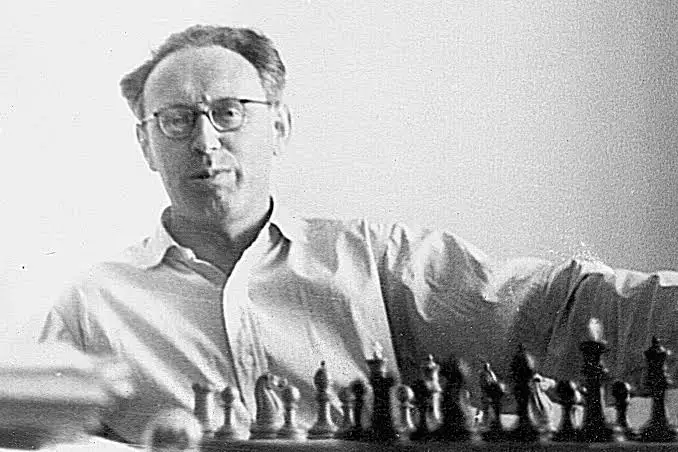
World Champion 1948 – 1957, 1958 – 1960, 1961 – 1963, winner of the 1948 tournament and four title matches (1951, 1954, 1958, 1961)
Ranking: According to Chessmetrics, he was the world number one for a total of 133 months (11 years) between September 1936 and May 1958. On the FIDE list, he ranked as high as seventh.
Highest FIDE Elo rating: 2630
Tournament career: Winner of 15 super-tournaments:
World Championship 1948
6-time winner of the USSR Championship
Winner of the very significant tournaments Nottingham 1936 and Groningen 1946
Winner of the Hastings International Chess Congress 1961/62, Tata Steel Masters 1969, and several others…
Chess Olympiads: six team gold medals, two gold, one silver, and two bronze individual medals
What earned him this:
The patriarch of the Soviet chess school, Mikhail Botvinnik, was a personality who defined the post-war era of world chess. He was a staunch communist devoted to the regime, an incredible chess worker and professional, and a player with an immense will to win. When Magnus Carlsen relinquished the world champion title a few years ago, I heard a comment somewhere that such a thing would never have occurred to Botvinnik, and he would not have understood it. I think this perfectly captures his character. Through his chess successes, he earned the status of a national hero in the USSR, which ensured his integrity even in later times when he was no longer a favorite of the government.
After World War I, the Soviet leadership aimed to prove the intellectual superiority of its ideology over the decadent West and chose chess as the means to achieve this. A state chess program was created with the sole goal of raising a generation of players who would seize and hold the world champion title. It was also desirable for this world champion to be completely devoted to the regime and the idea of socialism. Mikhail Botvinnik was the first result of this effort. He rose to prominence during the 1930s, gradually establishing himself as the leader of the Soviet chess school. However, a major success on the international scene outside the USSR was still needed, which no one had achieved until then.
Then came the famous tournament in Nottingham in 1936. One of the strongest tournaments in history, featuring five past, present, or future world champions – Lasker (for whom it was the last tournament), Capablanca, Alekhine, Euwe, and Botvinnik. Besides them, Fine, Reshevsky, Flohr, and others played. Botvinnik won this tournament with the same score and better tiebreaks than Capablanca, with the then world champion Euwe finishing behind them. Botvinnik suddenly became one of the main contenders for the title, but a year later, Alekhine played a rematch with Euwe and took back the title. In 1938, the AVRO tournament was held in the Netherlands for the world’s top eight players, and the winner was to become Alekhine’s next challenger. Botvinnik failed to win the tournament, and soon after, World War II began, putting plans for the world title on hold.
Botvinnik used the war years to improve his chess and prepare for an attack on the title. After the fighting ended, the winner of the AVRO tournament, Paul Keres, was no longer the same Keres – the war had affected him – and Botvinnik sensed an opportunity. However, the situation became more complicated when Alekhine died in 1946. That year in the fall, the first post-war super-tournament was held in Groningen, and Botvinnik confirmed his status by winning it ahead of Euwe, Smyslov, Najdorf, and others. Alekhine’s death then became an opportunity for FIDE to take control of the world championship and transform it into regular three-year cycles with clear rules and qualification paths.
However, before these cycles could begin, a world champion was needed, so the 1948 World Championship tournament was organized, featuring five players – Botvinnik, Smyslov, Reshevsky, Keres, and Euwe. They finished in this order, and Botvinnik officially became the sixth world champion. Rumors circulate that the Soviet leadership ordered Keres not to stand in Botvinnik’s way and let him win the tournament. While Botvinnik was Russian and a staunch communist, Keres was Estonian, and his loyalty to the regime was questionable – after the Soviet occupation of Estonia, he unsuccessfully tried to flee to the West. During the war, when Estonia was occupied by the German army, he played in Nazi-organized tournaments. It was therefore understandable that the Soviet leadership wanted to see Botvinnik as the winner, not his main competitor. It is uncertain how much this influenced the tournament’s outcome, but the truth is that Keres defeated everyone else and lost four out of five games to Botvinnik.
In the following years, Botvinnik completely withdrew from tournaments and was not a very active world champion. He focused only on defending his title. Between 1951 and 1963, he played a total of seven matches with an overall negative score, which is very interesting. The first two matches – 1951 with Bronstein and 1954 with Smyslov – ended in a draw 12:12, meaning Botvinnik retained the title. 1957 – loss to Smyslov and loss of the title. 1958 – victory in the rematch. 1960 – loss to Tal and loss of the title. 1961 – victory in the rematch. 1963 – loss to Petrosian and definitive loss of the title.
After 1963, he briefly returned to tournament play with good results, and his last major event was the USSR vs World match in 1970, where he played on the eighth board and defeated Matulović.
Botvinnik was undoubtedly a generational player, but two things keep him out of the top 10 in my eyes: his overall negative score in title matches and his seemingly somewhat paved path to the title thanks to the Soviet leadership.
Best games:
Mikhail Botvinnik vs José Raul Capablanca
AVRO 1938
1.d4 Nf6 2.c4 e6 3.Nc3 Bb4 4.e3 d5 5.a3 Bxc3+ 6.bxc3 c5 7.cxd5 exd5 8.Bd3 O-O 9.Ne2 b6 10.O-O Ba6 11.Bxa6 Nxa6 12.Bb2 Qd7 13.a4 Rfe8 14.Qd3 c4 15.Qc2 Nb8 16.Rae1 Nc6 17.Ng3 Na5 18.f3 Nb3 19.e4 Qxa4 20.e5 Nd7 21.Qf2 g6 22.f4 f5 23.exf6 Nxf6 24.f5 Rxe1 25.Rxe1 Re8 26.Re6 Rxe6 27.fxe6 Kg7 28.Qf4 Qe8 29.Qe5 Qe7 30.Ba3 Qxa3 31.Nh5+ gxh5 32.Qg5+ Kf8 33.Qxf6+ Kg8 34.e7 Qc1+ 35.Kf2 Qc2+ 36.Kg3 Qd3+ 37.Kh4 Qe4+ 38.Kxh5 Qe2+ 39.Kh4 Qe4+ 40.g4 Qe1+ 41.Kh5 1-0
Support the author and help create more articles
Research and writing take hours. Your contribution keeps ChessDB.cz free of annoying ads and enables more frequent writing.
- 🎯 more quality articles
- ⚡ faster tool development
- 🖥️ server maintenance
Share
Miroslav Janeček graduated in English Philology at Palacký University Olomouc. Currently he works in Prague as a content editor for a large marketing company. His roots are in Opava - the historic and cultural centre of the Czech part of Silesia. That city is also the home of Slezan Opava, the chess club where Miroslav started to play chess, later went on to work as a youth coach and which he to this day proudly represents. As an aspiring chess publicist, he is the main author of articles on ChessDB.cz. In his free time, in addition to chess and writing, he also devotes himself to racket sports, history, and literature.